
15 Surprising Things You Never Knew About the History of Letter Writing and Mail
Get Ready to be Surprised!
Did you know people were writing letters thousands of years before there was any such thing as a mailbox?
Getting a letter from one place to another used to be a real adventure. There were no trucks, no planes, and no zip codes.
Here are 15 fun facts about how we got from "please carry this note for me" to the mail system we know today.
Each fact comes with a Talk About It prompt. Use it to start a conversation, spark a friendly debate, or turn it into a quick journal or writing exercise. However you use them, they're a fun way to get kids thinking about how differently people used to communicate.
1. Letters are way older than mail. People have been writing letters for thousands of years. But a real mail system, where anyone could send a letter and trust it would get delivered, is actually pretty new in the grand scheme of history. For most of the past, if you wanted to send a letter, you had to figure out how to get it there yourself.
Talk About It: If there were no post office or email, who would you trust to deliver an important message for you?
2. Ancient Persia had a real-life relay race... for messages. Around 2,500 years ago, the Persian Empire set up a system of riders on fast horses who passed messages along a chain of stations, kind of like a relay race baton. It was one of the earliest fast-delivery systems ever built.
Talk About It: If you had to set up a relay team to carry a letter to someone special, how many people would you need, and where would you put each "station"?
3. The Romans could deliver a message 50 miles in a single day. The Roman Empire ran a network of roads and stations with fresh horses always waiting, called the cursus publicus. Riders could cover about 50 miles a day, which was seriously fast in a world with no cars.
Talk About It: How far do you think you could travel in one day if you had to walk, ride a bike, or ride a horse?
4. But regular people couldn't use those speedy systems. Both the Persian and Roman message networks were only for official government business. If you were just a regular person wanting to write to a friend, you were out of luck, because those routes were not open to everyone.
Talk About It: Why do you think it is important that mail systems are available to everyone today?
5. So everyday letters "hitchhiked" with travelers. For most of history, if you wanted to send a personal letter, you'd hand it to anyone headed in the right direction: a monk, a merchant, a pilgrim, or even a butcher on a trip. There was no guarantee, but it was often the only option.
Talk About It: What might happen if your letter had to travel from person to person before reaching its destination?
6. Merchants basically invented the first "shipping companies." By the 1200s, big Italian trading families in cities like Florence and Venice had grown too large to carry their own letters and goods themselves. So they created private courier services with riders on fixed routes to stay connected with business partners.
Talk About It: If you could invent your own way to deliver messages, what would it be?
7. Some merchants pooled their mail together instead of paying alone. In 1357, seventeen different trading companies in Florence realized it was too expensive for each of them to run their own courier service. So they teamed up and shared one system instead, splitting the cost between all seventeen companies.
Talk About It: Why do you think working together helped everyone?
8. A private family ran mail across an entire continent before public post offices existed. In the 1500s, a family called Thurn und Taxis built a mail delivery network that stretched across much of Europe. This private business existed centuries before governments offered mail service to ordinary people.
Talk About It: If you were in charge of delivering mail across a whole continent, what would be your biggest challenge?
9. America's first "post office" was inside a tavern. In 1639, a tavern owned by Richard Fairbanks in Boston became the official spot where mail crossing the ocean was dropped off and picked up. Taverns back then were community gathering places, so it made sense that people would swing by to check for mail while they were there anyway.
Talk About It: If you could put a mini post office inside any store or building today, where would you choose to put it?
10. Early American mail was mostly about staying in touch with England. Back in colonial times, most letters were not traveling between American towns. Instead, they crossed the ocean, connecting colonists with family and business contacts in England.
Talk About It: How long do you think it took back then? Follow a letter across the pond to see how long it takes now.
11. Ben Franklin ran the post office. Franklin helped run the colonial mail system, and one of his big ideas was making sure all kinds of newspapers could travel through the mail, not just the ones the government approved.
Talk About It: What kinds of information do you think every community should have access to?
12. The early mail carried way more newspapers than letters. After the United States became its own country, newspaper postage was kept very cheap on purpose, while letters cost more. The goal was to keep people informed and connected across a large, growing nation.
Talk About It: If you started a newspaper for kids, what stories would you include?
13. Believe it or not, the person who received a letter used to have to pay for it, not the sender. Before 1840 in Britain, mailing a letter was expensive and confusing, and it was usually the receiver who paid when the letter arrived. If they could not afford it, the letter was returned.
Talk About It: Would you open a letter if you had to pay for it first? Why or why not?
14. One schoolteacher's big idea changed mail forever. In 1837, a British schoolteacher named Rowland Hill suggested something unusual for the time: what if sending any letter, anywhere in the country, cost just one penny and the sender paid ahead of time? In 1840, his idea became reality and was called the Penny Post.
Talk About It: What everyday problem would you like to solve with a clever new idea?
15. Letter writing more than DOUBLED in a single year. Once mail became cheap and simple, people wrote letters everywhere. In Britain, the number of letters sent jumped from about 76 million to 168 million in just one year, and nearly doubled again over the next decade. Affordable postage helped create the modern habit of writing to the people you love.
Talk About It: Do you think handwritten letters feel different from texts or emails? Why?
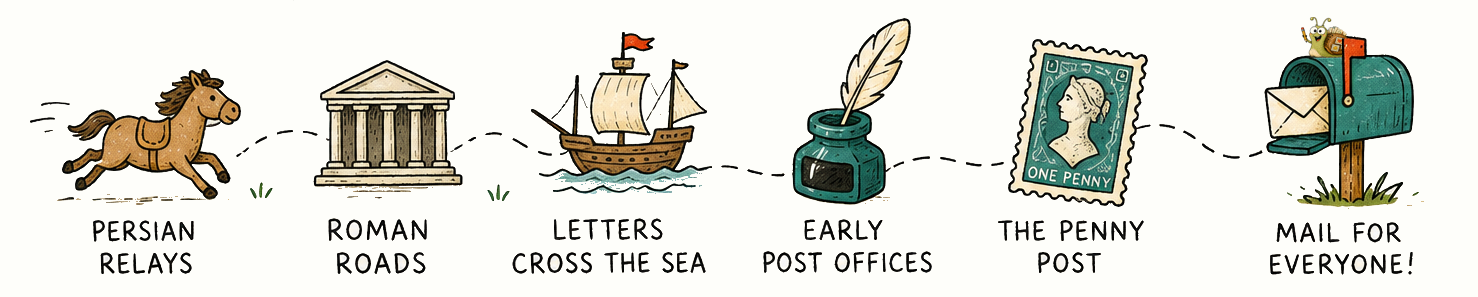
So next time you drop a letter in the mailbox, remember: you're taking part in something people have been doing for thousands of years, from horseback relay races to the penny stamp that changed everything.